In investment banking, private equity, and hedge funds, a single computational typo in a client pitch book can compromise a $750 million transaction. That is why recruitment teams at Goldman Sachs, Morgan Stanley, J.P. Morgan, Lazard, and Evercore evaluate candidate resumes with zero tolerance for error.
Junior bankers and HR screeners spend approximately 10 seconds conducting first-round resume audits. If your margins are off by 2 millimeters, if your document overflows onto a second page, or if your bullet points describe daily tasks rather than deal transaction sizes and financial metrics, your resume is discarded immediately.
In this definitive guide, we will break down the exact Wall Street 1-page formatting anatomy, decode the high-finance transaction bullet formula, and demonstrate how to format your financial modeling experience to land Bulge Bracket interviews.
- Strict 1-Page Mandate: Submitting a 2-page resume for an Analyst, Associate, or VP banking position is an automatic disqualifier.
- Zero Graphic Fluff: No headshot photos, no color skill bars, and no multi-column creative sidebars. Wall Street demands dense, elegant, single-column executive typography.
- Quantify Financial Scope: Every deal, financial model, or valuation comps bullet must state transaction values ($M/$B), EBITDA multiples, or basis point yields (bps).
- The 1-Line Personal Interest Section: The bottom line of your resume must include specific, quirky personal interests used by MDs as interview icebreakers.
1. The 10-Second Wall Street Screen: What Reviewers Evaluate
First-round screening at Goldman Sachs is executed by second-year analysts and associates who regularly work 80+ hour workweeks building complex financial models.
During their 10-second inspection, they evaluate 3 key pillars:
- Academic & Quantitative Pedigree: Target university, GPA (3.7+ strongly preferred), Dean's List honors, and finance coursework.
- Technical Modeling Rigor: DCF (Discounted Cash Flow), LBO (Leveraged Buyout), trading/transaction comps, Capital IQ, Bloomberg Terminal, and Python/SQL.
- Obsessive Attention to Detail: Consistent punctuation, aligned right-tab dates, and uniform font hierarchies.
2. The Non-Negotiable 1-Page Wall Street Hierarchy
On Wall Street, brevity is respect. A 2-page resume signals an inability to distill complex financial data into concise executive summaries.
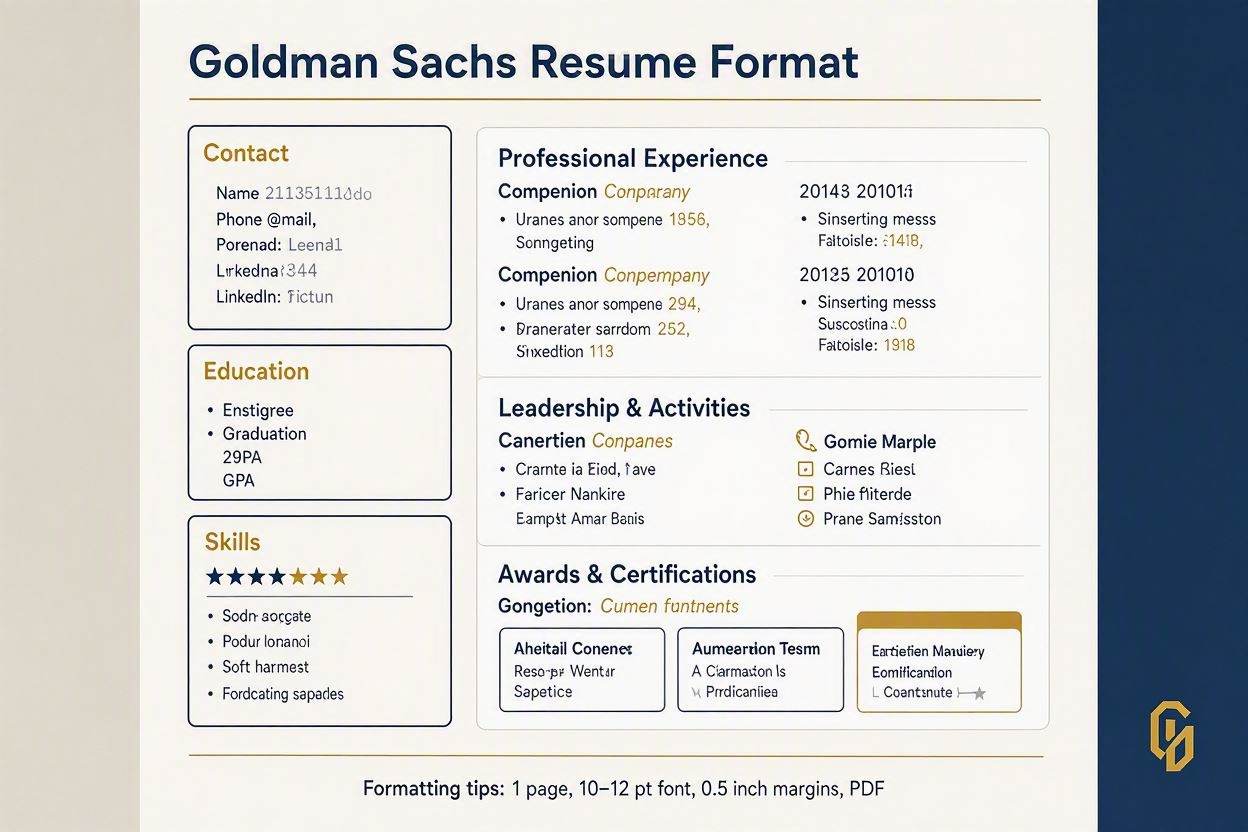
- Header: Name (16pt bold serif or clean sans), Phone, Professional Email, LinkedIn URL, City/State.
- Education: Top section for undergrads and MBA grads (GPA, SAT/GMAT, Honors, Relevant Coursework).
- Work Experience: High-density chronological reverse order highlighting deal size ($) and modeling methodologies.
- Leadership & Activities: Student investment fund leadership, varsity athletics, or financial club officer roles.
- Skills & Personal Interests: Financial tools + 1 line of unique personal hobbies (e.g., "Marathon Runner (PR 2:58), Classical Cellist, 19th Century History").
3. High-Finance Financial Metrics & Modeling Matrix
| Banking Sub-Field | Core Financial Metrics to Include | Technical Tools |
|---|---|---|
| M&A / Investment Banking | Transaction value ($M), EV/EBITDA multiples, Synergies ($), Accretion/Dilution (%) | Excel (Advanced macros), PitchBook, CapIQ |
| Private Equity & Credit | LBO returns, MOIC (Multiple on Invested Capital), Target IRR (%), Debt capacity | LBO Model, Bloomberg Terminal |
| Equity Research & Quant | Coverage universe ($B Cap), Alpha generation, Basis points (bps), Price targets | Python, SQL, FactSet, R |
4. The M&A Transaction Bullet Formula
[Financial Action Verb] + [Deal Scope / Asset Size ($)] + [Modeling Methodology] $\rightarrow$ [Executive Outcome]
5. Real Before & After Wall Street Bullet Comparisons
6. Formatting with Wall Street Templates on ABCD Resume
Do not waste hours wrestling with invisible tab stops in Microsoft Word.
On ABCD Resume, templates such as "Quant Finance (Red Accent)" and "Corporate CFO Pro" are pre-configured with executive typography, high-density margins, and automatic 1-page balancing.
Paste your deal notes into the live chat, and let our Gemini AI Agent structure your financial achievements into Wall Street-ready bullet points in seconds.