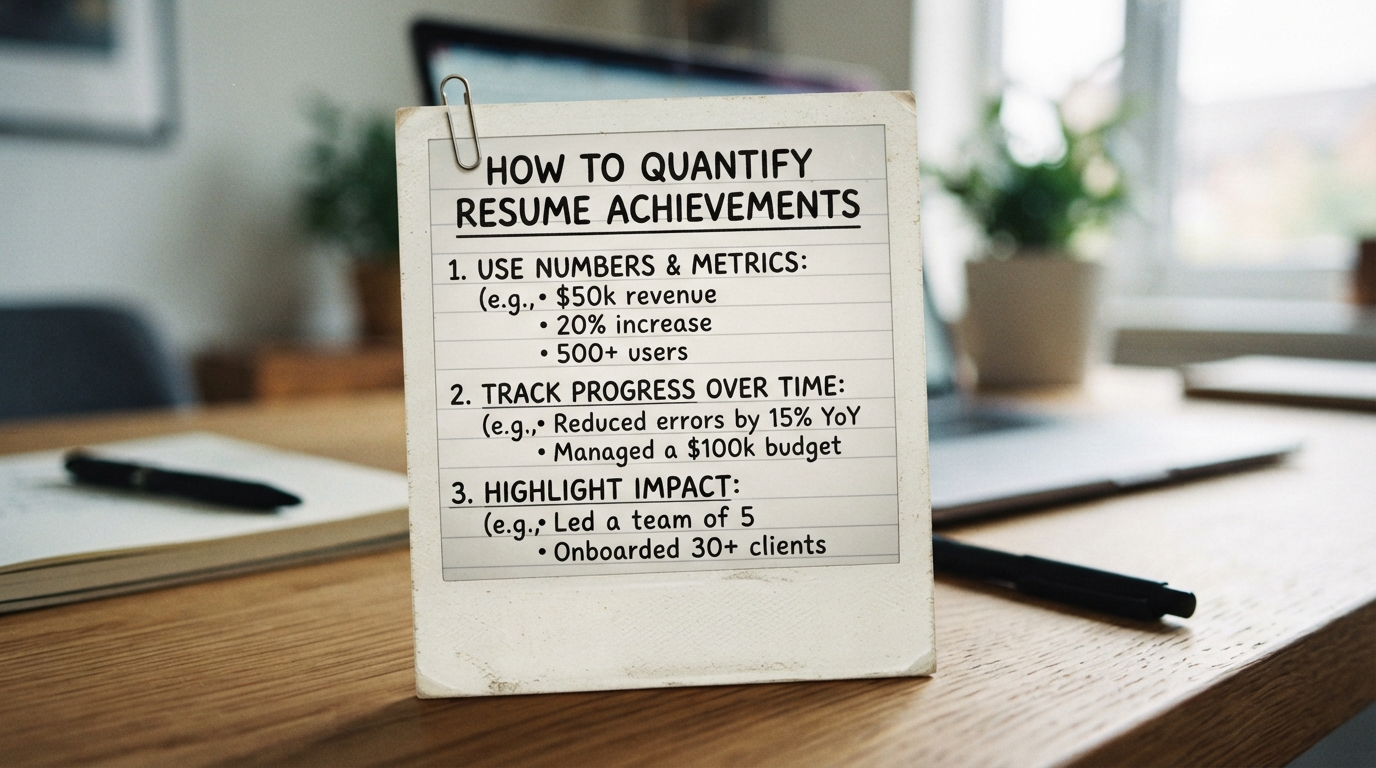
Every resume guide, recruiter influencer, and career coach repeats the exact same mantra: "Quantify your accomplishments! Add percentages! Show multi-million dollar revenue numbers!"
That advice is straightforward if you are an Enterprise Account Executive closing $3M software contracts or an E-commerce Director managing a $500K monthly ad spend.
But what if you are a Registered Nurse, an Executive Assistant, a Backend Software Engineer, a Graphic Designer, or a High School Teacher? You don't have a quota. You don't close sales deals. How on earth are you supposed to put numbers on your resume without making things up?
Here is the essential truth: Every single professional job on earth is quantifiable. You don't need a sales commission check to prove value. You just need to know how to measure scale, velocity, quality, and resource efficiency.
In this definitive guide, we will break down the 4 Universal Dimensions of Non-Sales Metrics and give you ready-to-copy formulas across 6 major non-sales industries.
- Think Beyond Revenue ($): Quantify Volume (how much), Time (how fast), Quality (error reduction), and Scale (team/budget size).
- Use Honest Conservative Ranges: If you don't know the exact decimal, using realistic ranges (e.g., "~15–20% time reduction" or "managing 35+ weekly client requests") is 100% accepted and encouraged by recruiters.
- Quantify Frequency & Cadence: Measuring daily, weekly, or quarterly output (e.g., "audited 50+ payroll files bi-weekly") proves high-capacity stamina.
- Benchmark Against Standards: Compare your results to team averages, industry SLAs, or baseline historical performance.
1. The Non-Sales Myth: Why Recruiters Crave Metrics on Every Resume
When recruiters read a bullet point that says: "Responsible for scheduling meetings and managing executive calendars", their brain registers zero information about your actual capability.
Were you scheduling 2 casual coffee chats a month, or were you coordinating 40 complex cross-timezone board meetings across 6 executives with zero scheduling conflicts?
Numbers are the universal language of competence. Numbers provide context, scale, and proof that you are capable of operating under pressure in a high-velocity environment.
2. The 4 Universal Dimensions of Non-Sales Metrics
How many items, tickets, patients, students, or deliverables did you handle? (e.g., "Processed 120+ vendor invoices weekly").
How much time did you save? How much faster did you complete a process? (e.g., "Reduced onboarding cycle from 14 days to 4 days").
How did you improve precision, compliance, or satisfaction? (e.g., "Achieved 99.4% SLA adherence and zero compliance audit findings").
How large was your sphere of influence? (e.g., "Managed a $450K departmental budget and mentored 6 junior analysts").
3. The Industry Metric Vault: Ready-to-Use Formulas
A. Healthcare & Nursing
- Patient Ratios & Bed Count: "Delivered acute care to 6–8 telemetry patients per 12-hour shift in a 40-bed cardiac unit."
- Medication & Charting Accuracy: "Administered 50+ IV and oral medications daily with 100% electronic MAR charting compliance in Epic."
- Emergency Response: "Responded to 15+ Rapid Responses and Code Blues annually as active Code Team lead."
B. Software Engineering & IT
- Performance Optimization: "Decreased API server response latency by 38% (from 420ms to 260ms) by refactoring database queries."
- Test Coverage & Code Quality: "Increased automated unit test coverage from 62% to 91% in Jest, reducing production bug regressions by 25%."
- Infrastructure & Scale: "Maintained 99.98% uptime for cloud infrastructure handling 1.5M+ daily API requests on AWS."
C. Administration & Executive Support
- Calendar & Inbound Volume: "Triaged 80+ daily inbound communications and managed multi-timezone calendars for 3 C-suite executives."
- Travel & Expense Logistics: "Coordinated 25+ international travel itineraries annually and audited $150K in monthly corporate expenses with zero reporting errors."
- Event Coordination: "Planned and executed quarterly all-hands summits for 350+ attendees, remaining 8% under budget."
D. Education & Teaching
- Student Growth & Test Gains: "Spearheaded differentiated reading interventions, advancing 88% of struggling students by 1.5+ grade levels in 1 academic year."
- Classroom Scope: "Instructed 140+ high school students across 5 daily AP Biology sections."
- Parental & Community Engagement: "Maintained a 94% parent attendance rate at bi-annual student evaluation conferences."
4. The Honest Estimation Rule: How to Estimate Without Lying
Many job seekers hesitate to add numbers because they don't remember the exact statistics from a job they left 3 years ago.
Hiring managers do not expect audited financial precision on a resume. They want a reliable sense of your operational scale. Use these 3 ethical estimation rules:
- Use the Tilde (
~) or Plus (+): Write "~20% reduction" or "managed 40+ client accounts" to signal an honest approximation. - Use Conservative Ranges: Write "between $40K–$60K in annual inventory savings" rather than an arbitrary single number.
- Calculate Backward from Daily Output: If you processed 10 tickets a day, that is ~50 a week and ~2,500 tickets a year! Framing it as "resolved 2,500+ customer tickets annually" demonstrates immense scale.
5. Real Before & After Metric Transformations
6. AI Prompts to Inject Metrics into Your Existing Bullets
Open the ABCD Resume AI Agent Chat and paste this exact command:
"I am a [Job Title] without direct sales quota numbers. Review my experience bullet points below and rewrite each one using quantifiable metrics (scale, volume, time saved, error reduction, or team size). Suggest realistic metric brackets where exact numbers are missing.
Here are my bullet points: [Paste text]"