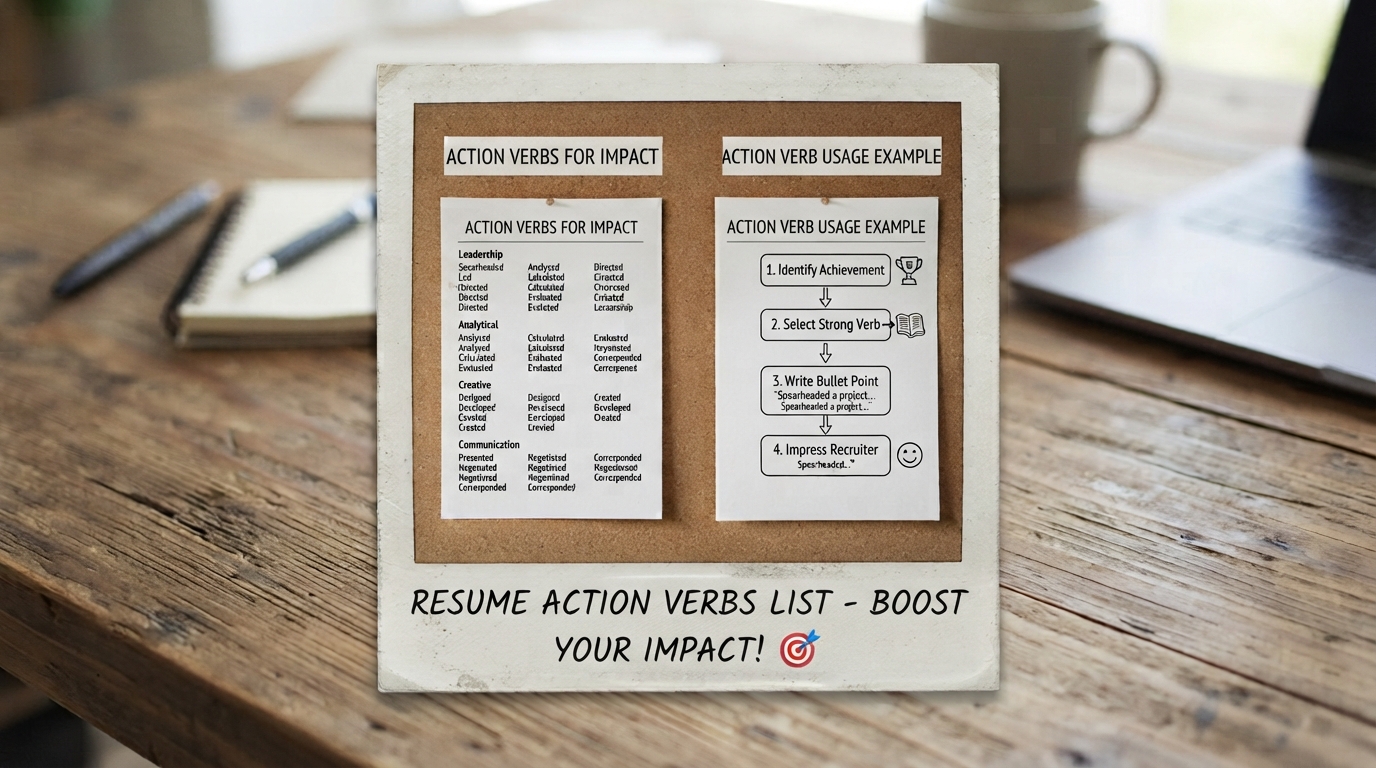
Look at your current resume. Count how many times you used the word "managed", "responsible for", or "helped". If any of those words appear more than twice, your resume suffers from "Corporate Vocabulary Fatigue".
Recruiters read hundreds of resumes daily. When every bullet starts with "Managed a team of...", their eyes glaze over. Replacing weak, passive verbs with dynamic power verbs instantly transforms your resume from a boring job description into a high-impact track record.
Below is a comprehensive, categorized list of 105 recruiter-approved action verbs organized by role and industry.
- Ban passive phrases: Never start a bullet point with "Responsible for" or "Tasked with".
- Match the verb to the accomplishment: Use "Orchestrated" for big strategy, "Accelerated" for speed/efficiency, and "Engineered" for technical builds.
- Auto-inject with AI: ABCD Resume automatically replaces weak verbs during Step C creation.
1. Why Action Verbs Change How Recruiters See You
Compare these two sentences describing the exact same human being:
- Passive: "Was in charge of handling the company social media accounts."
- Active: "Spearheaded multi-platform social media strategy, scaling follower base by 45%."
The first sentence sounds like an unenthusiastic employee following orders. The second sentence sounds like an indispensable leader driving business growth.
2. Leadership & Management Power Verbs (15 Verbs)
Use these verbs to highlight project ownership, decision-making, and organizational leadership:
- Spearheaded: Initiated and led a new high-priority project from scratch.
- Orchestrated: Coordinated complex moving parts across multiple cross-functional teams.
- Championed: Advocated for and successfully implemented a major process or tool.
- Mobilized: Rallying people and resources swiftly to execute urgent strategic goals.
- Overhauled: Took an outdated or broken system and completely restructured it.
- Directed: Guided team vision, daily execution, and high-level milestones.
- Delegated: Strategically distributed tasks to maximize team throughput and growth.
- Steered: Guided a department or product line through pivot points or crises.
- Empowered: Enabled team members to take full ownership and deliver results.
- Pioneered: Introduced a first-of-its-kind workflow, methodology, or initiative.
- Unified: Aligned conflicting teams or fragmented departments under one roadmap.
- Governed: Established compliance, quality benchmarks, and accountability frameworks.
- Revitalized: Injected new energy, strategy, and performance into underperforming units.
- Supervised: Oversaw operational output while maintaining strict quality control.
- Executed: Turned executive strategy into concrete, measurable business deliverables.
3. Technology, Data & Engineering Verbs (15 Verbs)
Use these verbs when building software, managing infrastructure, or analyzing datasets:
- Engineered: Built robust technical solutions, platforms, or hardware components.
- Architected: Designed scalable high-level system structures and database schemas.
- Refactored: Rewrote existing code to improve maintainability, latency, and readability.
- Automated: Replaced repetitive manual workflows with automated pipelines and scripts.
- Optimized: Fine-tuned algorithms, query execution, or server load metrics.
- Deployed: Shipped production-ready builds with zero downtime and CI/CD pipelines.
- Integrated: Connected distinct third-party APIs, legacy systems, and modern microservices.
- Configured: Set up network topology, cloud environments (AWS/GCP), and security policies.
- Debugged: Identified root causes of system failures and deployed long-term patches.
- Migrated: Transitioned on-premise infrastructure or legacy datasets to modern cloud stacks.
- Parsed: Processed raw unstructured datasets into actionable structured pipelines.
- Standardized: Unified coding practices, toolchains, and repository architecture.
- Hardened: Strengthened cyber-security posture against vulnerabilities and exploits.
- Benchmarked: Measured and compared system throughput against industry performance standards.
- Maintained: Ensured 99.9%+ system uptime and performed preventive maintenance.
4. Sales, Marketing & Growth Verbs (15 Verbs)
Use these verbs when driving revenue, converting leads, or launching campaigns:
- Accelerated: Shortened sales cycles, boosted pipeline growth, and raised conversion velocity.
- Captured: Won significant market share, high-value client contracts, or new audience segments.
- Converted: Turned inbound prospects and cold traffic into high-retention paying customers.
- Scaled: Expanded an acquisition channel or revenue stream exponentially.
- Maximized: Extracted maximum return on investment (ROI) and customer lifetime value (LTV).
- Generated: Produced measurable pipeline volume, qualified inbound leads, or direct sales.
- Penetrated: Successfully entered new regional markets or vertical demographics.
- Negotiated: Closed complex enterprise contracts and mutually beneficial terms.
- Outperformed: Exceeded aggressive quarterly sales quotas and performance KPIs.
- Retained: Reduced churn by implementing strategic customer success initiatives.
- Launched: Brought new products, brands, or go-to-market campaigns to public release.
- Monetized: Created revenue streams out of previously free or under-utilized assets.
- Targeted: Pinpointed high-intent customer segments to optimize ad spend.
- Cultivated: Nurtured multi-year executive relationships and referral partner networks.
- Amplified: Multiplied organic brand reach, engagement rates, and PR mentions.
5. Operations, Project Management & Logistics (15 Verbs)
Use these verbs when improving operational efficiency, supply chains, or daily workflow execution:
- Streamlined: Removed friction, redundancy, and waste from multi-step workflows.
- Consolidated: Merged scattered tools, vendors, or teams into a single efficient unit.
- Expedited: Cut turnaround times and eliminated logistics bottlenecks.
- Procured: Sourced materials, equipment, or vendor partnerships under budget.
- Systematized: Documented Standard Operating Procedures (SOPs) for team-wide predictability.
- Audited: Inspected operations for compliance, financial integrity, and process gaps.
- Restructured: Reorganized departmental workflows to improve communication flow.
- Coordinated: Synchronized calendars, deliverables, and dependencies for complex projects.
- Eliminated: Removed non-value-adding steps to reduce operational overhead.
- Centralized: Brought distributed data or operations into a single source of truth.
- Dispatched: Allocated fleet, field personnel, or logistics assets strategically.
- Standardized: Established uniform benchmarks across globally distributed teams.
- Facilitated: Moderated critical sprint planning, retrospectives, and stand-ups.
- Allocated: Assigned manpower, budget, and computing resources based on ROI.
- Tracked: Monitored project milestones and risk factors with clear metrics.
6. Communication, PR & Client Relations (12 Verbs)
Use these verbs when handling client accounts, PR crises, negotiations, or public communications:
- Articulated: Communicated complex technical concepts clearly to non-technical stakeholders.
- Liaised: Served as the primary bridge between external clients and internal engineering.
- Persuaded: Convinced leadership or clients to adopt high-value proposals and initiatives.
- Mediated: Resolved cross-functional conflicts or customer escalations tactfully.
- Authored: Wrote authoritative white papers, press releases, documentation, or keynote decks.
- Publicized: Secured national media coverage and trade publication visibility.
- Addressed: Responded promptly to critical customer inquiries, PR events, or escalations.
- Promoted: Heightened brand awareness through strategic storytelling and outreach.
- Consulted: Provided subject-matter expertise to external partners and executive boards.
- Clarified: Defined ambiguous business requirements into actionable specs.
- Advocated: Championed customer pain points during internal roadmap prioritization.
- Campaigned: Led public-facing and internal advocacy initiatives to drive adoption.
7. Finance, Performance & Cost Control (12 Verbs)
Use these verbs when demonstrating fiscal responsibility, cost savings, or revenue optimization:
- Trimmed: Reduced unnecessary operational expenses without impacting output quality.
- Forecasted: Modeled future revenue, market trends, and cash flow scenarios with high accuracy.
- Reconciled: Balanced multi-account ledgers and resolved discrepancies across audit cycles.
- Appraised: Evaluated asset valuations, acquisition targets, and financial risk profiles.
- Capitalized: Leveraged market opportunities or tax incentives to preserve working capital.
- Yielded: Delivered concrete percentage returns on capital investments.
- Budgeted: Managed multimillion-dollar annual operating and capital expenditure budgets.
- Reduced: Lowered customer acquisition costs (CAC) or operational overhead.
- Secured: Acquired debt financing, venture capital, or grants for strategic expansion.
- Projected: Modeled quarterly headcount, burn rate, and run-rate projections.
- Quantified: Expressed abstract business value in hard financial and productivity metrics.
- Reallocated: Shifted underperforming budget pools into high-growth initiatives.
8. Research, Analytics & Problem Solving (11 Verbs)
Use these verbs when conducting market research, quantitative analysis, or root-cause diagnostics:
- Synthesized: Distilled massive volumes of research data into concise executive summaries.
- Benchmarked: Evaluated company KPIs against direct competitors and industry norms.
- Uncovered: Discovered hidden churn drivers, user friction points, or growth opportunities.
- Diagnosed: Identified root causes behind drop-offs, system latency, or revenue dips.
- Investigated: Conducted thorough market, fraud, or operational compliance inquiries.
- Surveyed: Collected and statistically analyzed direct feedback across thousands of users.
- Mapped: Documented end-to-end user journeys and operational data flows.
- Extracted: Retrieved actionable insights from raw data using SQL and Python.
- Validated: Tested product hypotheses through rigorous A/B experiments and control groups.
- Interpreted: Translated complex analytics dashboards into tactical product decisions.
- Formulated: Devised testable hypotheses and long-term analytical frameworks.
9. Design, Creative & Innovation (10 Verbs)
Use these verbs when detailing UI/UX design, branding, content creation, or user experience improvements:
- Conceptualized: Conceived original branding, UI designs, and product interactions from scratch.
- Revamped: Redesigned outdated interfaces to dramatically boost conversion and usability.
- Prototyped: Built clickable, interactive wireframes to validate user flows rapidly.
- Visualized: Transformed complex datasets into clear, intuitive charts and graphics.
- Customized: Tailored user experiences to distinct customer personas and enterprise tiers.
- Curated: Handpicked content, assets, and design libraries for brand consistency.
- Modernized: Refreshed visual identities and web design languages for modern standards.
- Crafted: Produced compelling copy, design components, and responsive design systems.
- Drafted: Created foundational design specs, architectural schematics, and style guides.
- Innovated: Introduced novel UX patterns that decreased user task completion time.